

Real-Time Load Tracking: Turn Visibility into Shipper Trust
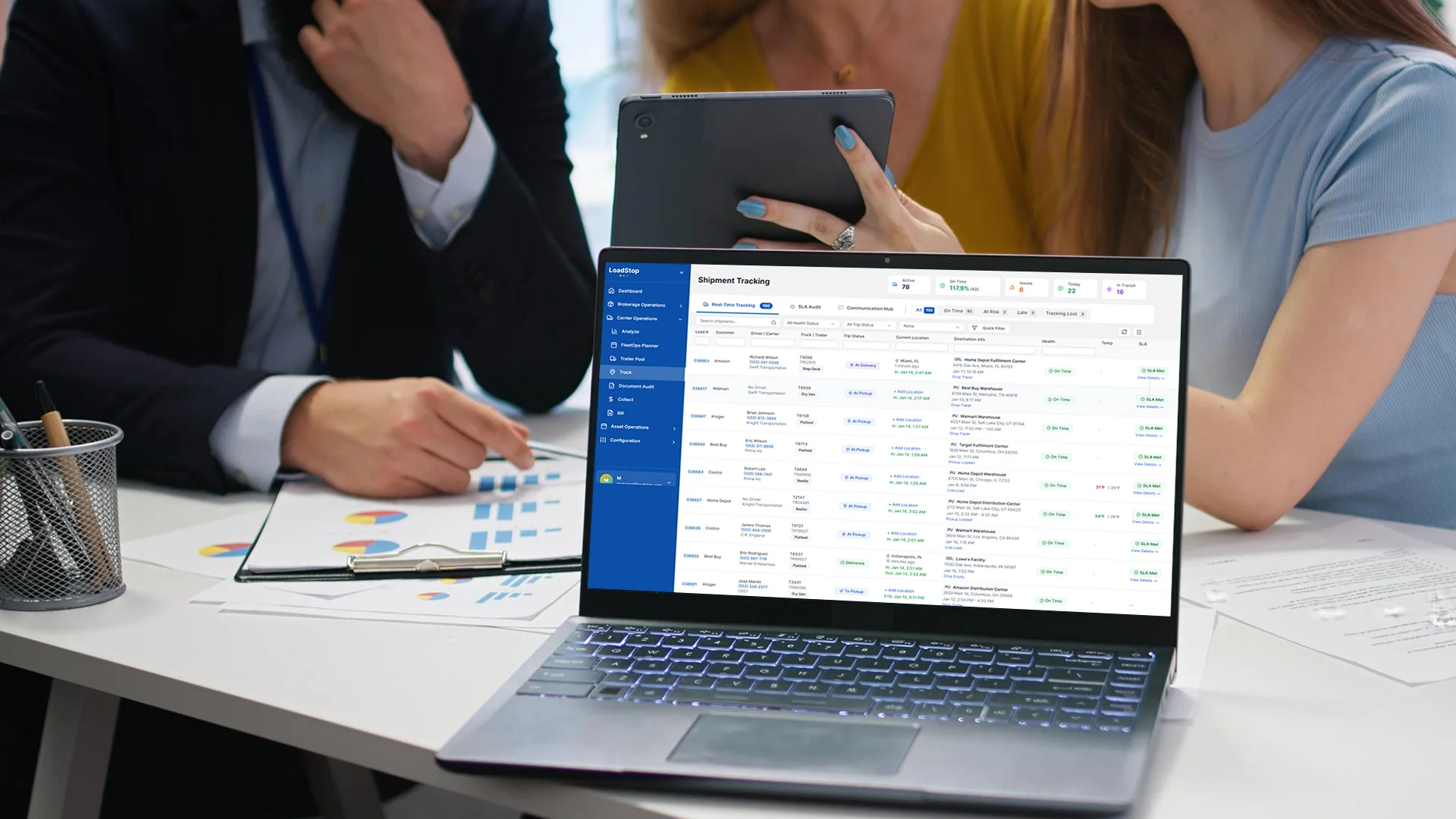
Shippers have always wanted to know where their freight is. What’s changed is the level of visibility they expect—and the consequences when they don’t get it.
Today, real-time load tracking is no longer a “nice-to-have” feature. For many shipper operations teams, it’s a requirement for onboarding, a key scorecard metric, and a daily SLA expectation—on par with on-time pickup and on-time delivery.
This shift directly impacts carriers, who are responsible for execution and communication, and brokers or 3PLs, who manage shipments end-to-end.
This guide explains what real-time tracking actually is, how it works, what shippers mean by “visibility,” and why it’s essential for maintaining strong shipper relationships. It also covers how LoadStop simplifies shipment visibility through ELD integrations, driver mobile tools, automation, and AI-driven exception management.
Real-Time Load Tracking: What It Really Means
At its core, real-time load tracking is the continuous ability to monitor a shipment’s location and status after it leaves its origin—along with enough context to determine whether it’s on schedule or at risk.
Gartner defines Real-Time Transportation Visibility Platforms (RTTVPs), such as Project44, FourKites, and FarEye, as systems that provide real-time location updates and shipment status insights. These platforms typically collect data through integrations like API/EDI, telematics feeds, and mobile applications.
In simple terms, real-time tracking is not just a map—it’s a system that delivers a consistent stream of location and milestone data to protect SLA performance when disruptions occur.
The Difference from Traditional Tracking
The main difference between traditional and modern tracking is timing and reliability.
Older tracking methods rely on periodic updates, such as manual check calls or delayed EDI messages. Modern systems use live telematics and mobile data to generate real-time milestones and alerts.
Inbound Logistics highlights that newer platforms combine GPS, mobile tracking, and predictive analytics, replacing outdated EDI-based approaches and enabling proactive exception management.
What Shippers Expect to See
Shippers expect more than a location point—they expect milestone-based visibility aligned with their operations. Common tracking events include:
• Dispatched / en route
• Arrived at pickup
• Departed pickup
• Arrived at delivery
• Delivered
• Sometimes empty or return-to-yard
Many freight platforms require these updates throughout the shipment lifecycle, including pre-pickup dispatch status and final delivery confirmation.
Where Tracking Data Comes From
Real-time tracking typically relies on three main data sources:
• Telematics / ELD systems (GPS truck data)
• Driver mobile apps (location and status updates)
• System integrations (TMS, EDI, API connections)
Why Shippers Demand Visibility
Shippers don’t require visibility because it’s a trend—they require it because modern supply chains move too quickly for uncertainty.
McKinsey notes that track-and-trace systems provide “unprecedented transparency,” offering continuous updates throughout the order lifecycle. As delivery expectations accelerate, companies must improve both speed and reliability.
Additional McKinsey research shows customers expect products “anytime and anywhere,” with minimal time between order and delivery—making service performance a key differentiator.
Operationally, many shippers now operate with a control tower approach. Deloitte defines this as a system that enables real-time visibility, proactive exception handling, and predictive insights across the supply chain. Accenture similarly emphasizes real-time visibility and control as core to connected supply chains.
As a result, “visibility SLAs” have emerged. Shippers don’t just measure whether a shipment is late—they measure whether they were informed early enough to adjust labor, dock schedules, or customer commitments.
Accenture also notes that limited visibility weakens supply chain performance, with only about three in ten executives highly confident in their ability to anticipate disruptions. This uncertainty increases reliance on partners who provide consistent, real-time updates.
In simple terms: on-time delivery is the outcome; real-time visibility is the early warning system.
Why Carriers Need Real-Time Tracking
Carriers often view tracking as extra work, while shippers see it as reliability.
Delays from traffic, weather, or congestion are unavoidable—but how quickly those risks are identified and communicated is controllable. That’s what protects performance metrics and future business.
McKinsey reports that RTTVPs are widely adopted among U.S. carriers, reinforcing that visibility is becoming a standard expectation.
Carriers benefit in several ways:
• Fewer interruptions: Automated tracking reduces check calls and emails, improving safety and focus.
• Clearer dispute resolution: Documented location and milestone data help verify arrival times, dwell periods, and handoffs.
• Improved shipper relationships: Reducing “where’s the truck?” inquiries makes carriers easier to work with.
Inbound Logistics highlights how real-time tracking eliminates the need for constant manual follow-ups across calls, spreadsheets, and portals.
It’s also important to note that the ELD mandate already provides a foundation for tracking. The FMCSA requires ELDs to automatically record driving time and location data. This means carriers already have access to valuable data—the expectation now is to share it effectively.
Why Brokers and 3PLs Need It
For brokers and 3PLs, service perception is critical. Even flawless execution can fall short if the shipper lacks visibility.
Real-time tracking transforms capacity coverage into predictable outcomes by improving communication, operations, and carrier coordination.
Inbound Logistics notes that modern tracking systems not only provide location data but also enable proactive issue detection and long-term performance analysis—key advantages for brokers managing large volumes.
Visibility also supports self-service expectations. Shippers increasingly expect access to real-time tracking portals, reducing manual communication and enhancing transparency.
Additionally, tracking plays a role in fraud prevention. Some systems monitor anomalies in location data or device behavior and ensure tracking begins before sensitive shipment details are shared.
Many large networks now enforce tracking compliance, requiring automated updates and defined milestone reporting. Brokers must standardize and automate tracking processes to meet these expectations at scale.
How LoadStop Enables Real-Time Visibility
LoadStop approaches tracking as a complete visibility system, combining real-time location data, automated milestones, proactive alerts, predictive ETAs, and workflow automation.
It integrates multiple tracking sources—including ELDs, trailer tracking, mobile apps, rail, and temperature monitoring—to ensure consistent visibility across different carrier capabilities.
Key features include:
• Predictive ETA calculations
• Geofencing for automated updates
• Check call automation
• Detention tracking for accurate billing
These capabilities align directly with shipper expectations for accuracy, reliability, and accountability.
LoadStop for Carriers
Carriers need to balance ease of use with compliance.
LoadStop’s Driver App supports:
• One-tap load acceptance
• In-app status updates (picked up, delivered, delayed)
• Real-time tracking visibility for dispatch
• Fast document uploads for BOL and POD
Its ELD integrations use secure APIs to capture GPS location, hours-of-service data, and duty status in real time—supporting accurate ETAs and detention monitoring.
The result is reduced manual effort, fewer check calls, and fewer unexpected issues.
LoadStop for Brokers
Brokers require scalability and consistency across multiple carriers.
LoadStop addresses tracking gaps with AI-powered monitoring. It combines multiple data sources and detects when tracking becomes inconsistent or stops.
When gaps occur, the system automatically contacts drivers or carriers via phone, email, or text to retrieve updates. These are then unified into a single real-time view with alerts and updated ETAs.
This “gap fill” capability allows brokers to provide immediate, informed updates instead of delayed responses.
Automated milestone updates also reduce manual workload, improving data accuracy and operational efficiency.
LoadStop for Shippers
Even when shippers don’t directly use your system, they evaluate your service based on visibility.
LoadStop includes:
• Customer-specific update preferences
• A real-time tracking portal for shipment visibility
These features reduce follow-ups and strengthen collaboration between shippers, carriers, and brokers.
As supply chains become more complex, real-time visibility enables shippers to anticipate disruptions and respond proactively.
Turning Visibility into Trust
Shippers demand visibility because it reduces uncertainty—and uncertainty is costly.
For carriers, tracking improves performance metrics, reduces disruptions, and strengthens reliability. For brokers and 3PLs, it enhances customer experience through faster response times and fewer blind spots.
Real-time tracking is no longer just about knowing where a truck is. It’s about maintaining control—providing accurate ETAs, reliable milestones, and scalable communication.
Visibility alone provides information. Visibility combined with action drives better operations and builds lasting trust.
Today, real-time load tracking is no longer a “nice-to-have” feature. For many shipper operations teams, it’s a requirement for onboarding, a key scorecard metric, and a daily SLA expectation—on par with on-time pickup and on-time delivery.
This shift directly impacts carriers, who are responsible for execution and communication, and brokers or 3PLs, who manage shipments end-to-end.
This guide explains what real-time tracking actually is, how it works, what shippers mean by “visibility,” and why it’s essential for maintaining strong shipper relationships. It also covers how LoadStop simplifies shipment visibility through ELD integrations, driver mobile tools, automation, and AI-driven exception management.
Real-Time Load Tracking: What It Really Means
At its core, real-time load tracking is the continuous ability to monitor a shipment’s location and status after it leaves its origin—along with enough context to determine whether it’s on schedule or at risk.
Gartner defines Real-Time Transportation Visibility Platforms (RTTVPs), such as Project44, FourKites, and FarEye, as systems that provide real-time location updates and shipment status insights. These platforms typically collect data through integrations like API/EDI, telematics feeds, and mobile applications.
In simple terms, real-time tracking is not just a map—it’s a system that delivers a consistent stream of location and milestone data to protect SLA performance when disruptions occur.
The Difference from Traditional Tracking
The main difference between traditional and modern tracking is timing and reliability.
Older tracking methods rely on periodic updates, such as manual check calls or delayed EDI messages. Modern systems use live telematics and mobile data to generate real-time milestones and alerts.
Inbound Logistics highlights that newer platforms combine GPS, mobile tracking, and predictive analytics, replacing outdated EDI-based approaches and enabling proactive exception management.
What Shippers Expect to See
Shippers expect more than a location point—they expect milestone-based visibility aligned with their operations. Common tracking events include:
• Dispatched / en route
• Arrived at pickup
• Departed pickup
• Arrived at delivery
• Delivered
• Sometimes empty or return-to-yard
Many freight platforms require these updates throughout the shipment lifecycle, including pre-pickup dispatch status and final delivery confirmation.
Where Tracking Data Comes From
Real-time tracking typically relies on three main data sources:
• Telematics / ELD systems (GPS truck data)
• Driver mobile apps (location and status updates)
• System integrations (TMS, EDI, API connections)
Why Shippers Demand Visibility
Shippers don’t require visibility because it’s a trend—they require it because modern supply chains move too quickly for uncertainty.
McKinsey notes that track-and-trace systems provide “unprecedented transparency,” offering continuous updates throughout the order lifecycle. As delivery expectations accelerate, companies must improve both speed and reliability.
Additional McKinsey research shows customers expect products “anytime and anywhere,” with minimal time between order and delivery—making service performance a key differentiator.
Operationally, many shippers now operate with a control tower approach. Deloitte defines this as a system that enables real-time visibility, proactive exception handling, and predictive insights across the supply chain. Accenture similarly emphasizes real-time visibility and control as core to connected supply chains.
As a result, “visibility SLAs” have emerged. Shippers don’t just measure whether a shipment is late—they measure whether they were informed early enough to adjust labor, dock schedules, or customer commitments.
Accenture also notes that limited visibility weakens supply chain performance, with only about three in ten executives highly confident in their ability to anticipate disruptions. This uncertainty increases reliance on partners who provide consistent, real-time updates.
In simple terms: on-time delivery is the outcome; real-time visibility is the early warning system.
Why Carriers Need Real-Time Tracking
Carriers often view tracking as extra work, while shippers see it as reliability.
Delays from traffic, weather, or congestion are unavoidable—but how quickly those risks are identified and communicated is controllable. That’s what protects performance metrics and future business.
McKinsey reports that RTTVPs are widely adopted among U.S. carriers, reinforcing that visibility is becoming a standard expectation.
Carriers benefit in several ways:
• Fewer interruptions: Automated tracking reduces check calls and emails, improving safety and focus.
• Clearer dispute resolution: Documented location and milestone data help verify arrival times, dwell periods, and handoffs.
• Improved shipper relationships: Reducing “where’s the truck?” inquiries makes carriers easier to work with.
Inbound Logistics highlights how real-time tracking eliminates the need for constant manual follow-ups across calls, spreadsheets, and portals.
It’s also important to note that the ELD mandate already provides a foundation for tracking. The FMCSA requires ELDs to automatically record driving time and location data. This means carriers already have access to valuable data—the expectation now is to share it effectively.
Why Brokers and 3PLs Need It
For brokers and 3PLs, service perception is critical. Even flawless execution can fall short if the shipper lacks visibility.
Real-time tracking transforms capacity coverage into predictable outcomes by improving communication, operations, and carrier coordination.
Inbound Logistics notes that modern tracking systems not only provide location data but also enable proactive issue detection and long-term performance analysis—key advantages for brokers managing large volumes.
Visibility also supports self-service expectations. Shippers increasingly expect access to real-time tracking portals, reducing manual communication and enhancing transparency.
Additionally, tracking plays a role in fraud prevention. Some systems monitor anomalies in location data or device behavior and ensure tracking begins before sensitive shipment details are shared.
Many large networks now enforce tracking compliance, requiring automated updates and defined milestone reporting. Brokers must standardize and automate tracking processes to meet these expectations at scale.
How LoadStop Enables Real-Time Visibility
LoadStop approaches tracking as a complete visibility system, combining real-time location data, automated milestones, proactive alerts, predictive ETAs, and workflow automation.
It integrates multiple tracking sources—including ELDs, trailer tracking, mobile apps, rail, and temperature monitoring—to ensure consistent visibility across different carrier capabilities.
Key features include:
• Predictive ETA calculations
• Geofencing for automated updates
• Check call automation
• Detention tracking for accurate billing
These capabilities align directly with shipper expectations for accuracy, reliability, and accountability.
LoadStop for Carriers
Carriers need to balance ease of use with compliance.
LoadStop’s Driver App supports:
• One-tap load acceptance
• In-app status updates (picked up, delivered, delayed)
• Real-time tracking visibility for dispatch
• Fast document uploads for BOL and POD
Its ELD integrations use secure APIs to capture GPS location, hours-of-service data, and duty status in real time—supporting accurate ETAs and detention monitoring.
The result is reduced manual effort, fewer check calls, and fewer unexpected issues.
LoadStop for Brokers
Brokers require scalability and consistency across multiple carriers.
LoadStop addresses tracking gaps with AI-powered monitoring. It combines multiple data sources and detects when tracking becomes inconsistent or stops.
When gaps occur, the system automatically contacts drivers or carriers via phone, email, or text to retrieve updates. These are then unified into a single real-time view with alerts and updated ETAs.
This “gap fill” capability allows brokers to provide immediate, informed updates instead of delayed responses.
Automated milestone updates also reduce manual workload, improving data accuracy and operational efficiency.
LoadStop for Shippers
Even when shippers don’t directly use your system, they evaluate your service based on visibility.
LoadStop includes:
• Customer-specific update preferences
• A real-time tracking portal for shipment visibility
These features reduce follow-ups and strengthen collaboration between shippers, carriers, and brokers.
As supply chains become more complex, real-time visibility enables shippers to anticipate disruptions and respond proactively.
Turning Visibility into Trust
Shippers demand visibility because it reduces uncertainty—and uncertainty is costly.
For carriers, tracking improves performance metrics, reduces disruptions, and strengthens reliability. For brokers and 3PLs, it enhances customer experience through faster response times and fewer blind spots.
Real-time tracking is no longer just about knowing where a truck is. It’s about maintaining control—providing accurate ETAs, reliable milestones, and scalable communication.
Visibility alone provides information. Visibility combined with action drives better operations and builds lasting trust.
Are you lost in a sea of Logistics Providers?
TALK TO AN EXPERT

Copyright © 2025 b2bsupplychainconsultants.com. All rights reserved. | Privacy Policy | Designed by: PeterTheProgrammer.com